Pages

Showing posts with label color. Show all posts

Sunday, July 1, 2012

Color Theory Fun 2

My last "three colors and white" experiment turned out so well I decided to try it again (coulda' been a fluke, right?). But, this time I decided to try a different blue, one that I used a few times long ago and then abandoned because the results were so horrific. Prussian Blue.

So I dug around in my old supplies and came up with the crumpled metal tube that was my Prussian Blue from so long ago. When I do experiments like this, it is one of the few times I am glad I am a pack rat.

Cad. Yellow.........Cad. Red.........Prussian Blue........White

Clouds in Prussian Blue    8"x8"

Prussian Blue has won me over! Why did I hate it before? It's strong and can get out of hand if you are not careful, but what dynamite skies and green fields it makes. By using only three primary colors and white it becomes a much easier to achieve color harmony. 
Sometimes less is more!

Wednesday, June 20, 2012

Color Theory Fun

I love color theory, and though most of what I have learned usually confirms something I had already stumbled across, I am always up to trying something new. Or in this case, something old and very basic.

The first thing you learn in color theory is that ALL colors are made up of the basic three: Red, Yellow, Blue. Bear in mind that we are talking about mixing pigment here, not light.

                                  So here is my quick study using only three colors and white.
                     Cadmium Red......Cadmium Yellow........Ultramarine Blue.......Titanium White


Pine Tree Study in Three Colors

And, by golly, it works! With those three colors I was able to get a full range of palette colors.

Now, I won't be tossing out all my other beloved colors, but it does mean that I can be more confident about lightening the load when I take to field and forest in search of a good spot for plein air painting! The fewer colors I carry the lighter my pack. More to come.

Tuesday, September 13, 2011

A Moment in Time

Conventional wisdom by conventional artists says that morning light is cool and afternoon light is warm. But the other morning, as I started out on my morning walk, I hadn't even gotten out of the driveway before I was stopped in my tracks by the light shining on a group of tree trunks. They were lit with an intense reddish light that was made all the more dramatic by the cool blues in the mist shrouded background.
I couldn't get it out of my head and so I painted it as best I could. I wish I could paint with light instead of pigments so that everyone could see what I saw.


September Morning Light   16" x 20"

Sometimes conventional wisdom needs to be ignored.......

Tuesday, May 24, 2011

The Quality of Light

After visiting Arizona a little while ago, I now know why some artists so love painting out west. I could never understand it before. It's so barren, fewer and smaller trees, and the cool, blue-green mountains I  love are seldom to be found in the rocky landscape.

But there is something about the light. 

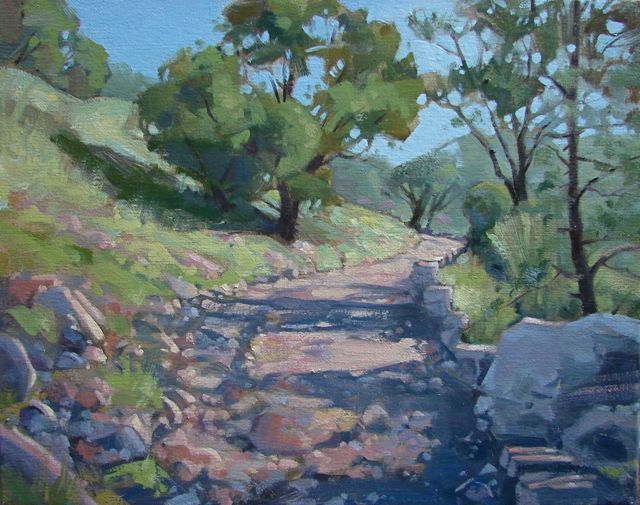
Perhaps because of the lack of moisture in the air, the skies seem bluer, the air clean and sharp. The boundaries between objects are clean and sharp, too. And you can see for miles! That light quality is beautiful to paint and opens up sharp colors and clear contrasts to the artist's eyes. I love it, too, now!

Thumb Butte Trail    11" x 14"

Monday, April 11, 2011

Color Palette Possibilities

People always seem to be interested in what my palette looks like, what colors I use and how I arrange them, so here it is:
For oils -

When I first started painting at age 13 my teacher showed me this way to set up my palette and I have done it this way ever since. I always know where the colors are and this saves me from searching as I work.

Upper left corner - Titanium white

Across the top, light to dark warms - Cad. yellow lt., yellow ochre, Winsor red (or Cad. red lt.), permanent rose, burnt sienna, burnt umber

Down the left side, light to dark cools - sap green, veridian green, cobalt blue, ultramarine blue, and sometimes Thalo blue


I often try out other colors and over the years some colors I use have changed, but this is my basic palette at the moment. Oils dry out on the palette, so once dry they get scraped off and thrown away.

For watercolors -

I never tackled watercolors seriously until I was in my 20s and my palette is set up differently, like a color wheel.  Think ROYGBIV! Red, orange, yellow, green, blue, indigo, (no violet, I mix that). Then earth tones down the right side. I use the same colors as in oils plus alizarine crimson, new gamboge, aureolin, manganese blue, thalo blue, raw umber, sometimes cerulean blue.

Because I work much faster in watercolor I have colors on my watercolor palette that I would mix myself if I were using oils. Saves me time that way.


I used to imitate the palette of whatever artist I was admiring at the time, but just because I was using the same colors didn't mean that my work looked like theirs. So, don't fall into that trap.

However, it did mean I got to try out a lot of different colors and find the ones that worked for me!

Tip: I never throw out watercolors, because even if they have dried out I can remoisten them by misting them and then putting a damp sponge inside the closed palette (all my watercolor palettes have lids). I just squeeze a little fresh paint on top of the old and I am ready to go!


Still making kits.....yuk!

Monday, April 4, 2011

Celebrate Color

I believe that color (or its absence) is probably the most exciting and influential element in artworks. Though it is second to design in its importance, it exerts an immediate and spontaneous influence on us as we look at a work on art.


Color wheel
Basic Color Wheel
And, I have always loved the color wheel, in all its many manifestations. But, I hardly ever use it! From the time I first began to paint I have always used color instinctively, knowing what colors to mix to get what I needed. Studying color theory when I reached college only served to reinforce what I was already doing, and explained why what I was doing worked.

But if color doesn't come easy for you, you can learn how color works and how to utilize that knowledge.
Here's a good place to go, if you want to learn more about color.

Color possesses four qualities :
Hue - what we usually just call "color"
Value - the lightness (a tint) or darkness (a shade) of a color.
Intensity or saturation - emerald is more intense than olive, but they are both green
Temperature - there are warm reds (cadmium red) and cool reds (alizarine crimson), etc. This is true for all colors. In the watercolor below, can you see warm blues and cool blues?


Honey Jars in GA - Dottie Hoeschen
In a future post I will talk more about colors that I use and why......